

The automotive industry demands grinding processes capable of maintaining tight tolerances, repeatable surface finishes, and consistent performance across high-volume production runs. Components such as crankshafts, camshafts, gears, bearings, cutting tools, and other precision parts may require very different grinding wheel specifications depending on the material being machined and the operation being performed.
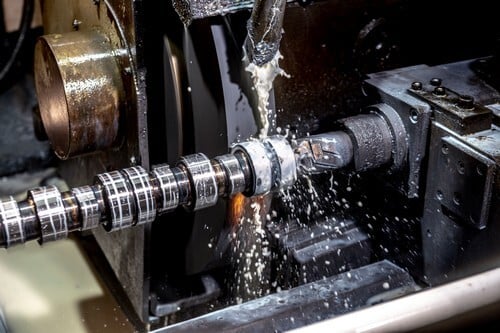
This is where diamond and CBN superabrasive wheels can provide significant advantages over conventional abrasives. Their hardness, wear resistance, and ability to maintain a consistent cutting surface make them valuable for demanding automotive applications where wheel wear, dimensional accuracy, cycle time, and surface finish directly affect production efficiency.
However, there isn't one diamond or CBN wheel that is right for every automotive application. Abrasive type, bond system, grit size, concentration, wheel geometry, and operating parameters all need to be matched to the material and grinding operation.
Here are five important types of diamond and CBN wheels used in automotive manufacturing and where each can provide the greatest benefit.
What to Look for in a Wheel for Automotive Manufacturing
The starting point for any wheel decision is understanding how the workpiece material itself dictates the abrasive.
Why Hardened Steels Require Superabrasive Wheels
Automotive manufacturing is one of the leading industries that rely on diamond and CBN grinding wheels, particularly for producing precision components and tooling where dimensional accuracy and durability cannot be compromised.
Hardened steels create particularly demanding grinding conditions. As hardness increases, conventional abrasives can experience accelerated wear, loss of form, and increasing grinding forces. That can result in more frequent dressing, greater variation between components, and increased downtime.
CBN is particularly well suited for hardened ferrous materials because it combines extreme hardness with excellent thermal and chemical stability when grinding these materials. Conventional abrasives can remain appropriate for softer steels and many other automotive grinding operations, so the decision should be based on the complete application rather than material type alone.
Diamond serves a different role. It is generally selected for hard, non-ferrous materials such as tungsten carbide, ceramics, certain composites, and other materials where diamond's exceptional hardness provides a significant grinding advantage.
The fundamental distinction is straightforward:
CBN is particularly suited to hardened ferrous materials, while diamond is used for carbide and other hard non-ferrous materials.
Selecting between the two should begin with the workpiece material rather than simply choosing the hardest available abrasive.
Precision, Dimensional Accuracy, and Production Volume
Automotive production often involves thousands of parts that must remain within a stringent tolerance range. A grinding wheel that performs well for the first few parts but gradually changes shape can create dimensional variation later in the production run.
Wheel selection therefore needs to consider more than material removal rate.
Manufacturers should evaluate:
- Dimensional tolerance requirements
- Required surface finish
- Workpiece material and hardness
- Stock removal requirements
- Production volume
- Wheel speed and machine capability
- Dressing requirements
- Coolant delivery
- Cycle-time objectives
The best wheel specification balances cutting efficiency, form retention, surface finish, wheel life, and overall process cost.
As automotive manufacturing evolves, electric vehicle production is creating additional precision-grinding requirements for components such as bearings, gears, shafts, electric motor components, and specialized tooling. The materials and grinding operations vary considerably, but the same selection principle applies: abrasive and bond specifications must be matched to the workpiece material, required tolerance, surface finish, machine, and production volume.
1. CBN Wheels for Crankshaft and Camshaft Grinding
Crankshafts and camshafts are a clear example of where this material-first approach matters most.
Why CBN Outperforms Conventional Abrasives on Hardened Steel
Crankshafts and camshafts require accurate geometry and consistent surface quality, making wheel performance particularly important in high-volume production.
For hardened-steel crankshafts, camshafts, and similar components, CBN can provide substantial advantages in wheel life, form retention, and grinding consistency compared with conventional abrasives. Its thermal stability and resistance to chemical wear when grinding hardened ferrous materials make it particularly valuable in demanding production environments.
The performance difference compared with conventional abrasives can be substantial.
In published grinding research involving fully heat-treated bearing steel, CBN wheels achieved G-ratios approximately 20 to 200 times greater than conventional aluminum oxide wheels. G-ratio measures the volume of workpiece material removed relative to the volume of grinding wheel wear.
For automotive manufacturers, a substantially higher G-ratio can translate into longer wheel life, fewer dressing interventions, reduced downtime, and greater dimensional consistency across extended production runs.
The exact improvement in a production application will depend on the material, machine, wheel specification, coolant, and grinding parameters. The published range should therefore not be interpreted as a guaranteed improvement for every crankshaft or camshaft operation.
Achieving Consistent Performance in High-Speed Production Grinding
Production grinding isn't simply about removing material quickly. The wheel must continue producing the required geometry and surface finish throughout the production cycle.
CBN wheels can help manufacturers maintain consistency by reducing wheel wear and maintaining the grinding profile over longer runs.
Wheel speed, feed rate, depth of cut, coolant delivery, and dressing strategy must still be optimized for the specific operation. An incorrectly specified or poorly applied CBN wheel will not automatically improve productivity simply because CBN is harder than conventional abrasive materials.
2. CBN and Diamond Wheels for Automotive Gear and Gear-Tool Manufacturing
Gear manufacturing adds another layer of complexity since both the gear and the tools used to cut it may need different abrasives.
Matching the Abrasive to the Gear or Tool Material
Gear manufacturing requires particularly careful abrasive selection because the correct wheel depends on what is actually being ground.
For hardened steel gears, CBN can be an appropriate superabrasive choice. Diamond should generally be avoided when grinding ferrous materials because diamond can experience accelerated chemical wear in contact with iron at elevated grinding temperatures.
Diamond grinding wheels serve a different role in gear manufacturing. They can be used for tool grinding, finishing, and sharpening carbide gear-cutting tools to extend tool life, as well as other hard, non-ferrous tooling materials used to manufacture gears.
This distinction is critical. The wheel should be selected according to the material actually being ground—not simply because an operation is associated with gear manufacturing.
Balancing Cutting Speed With Surface Finish
Gear-related grinding operations require a balance between efficient material removal and the surface quality needed for the finished component or cutting tool.
A coarser abrasive can generally improve stock removal but may leave a rougher surface. A finer abrasive can improve finish but may require different feed rates and grinding parameters.
The wheel specification should therefore account for:
- Workpiece material
- Required surface finish
- Geometry and tolerance
- Stock removal
- Machine rigidity
- Coolant application
- Production volume
Optimizing these variables together is more effective than selecting a wheel based on abrasive type alone.
3. Metal Bond Diamond Wheels for Demanding Automotive Applications
For hard, non-ferrous materials that demand extended wheel life, metal bond diamond wheels become a strong option.
Where Metal Bond Wheels Fit in Automotive Production
Metal bond diamond wheels provide exceptional wear resistance and form retention, making them useful for certain automotive manufacturing applications involving hard, non-ferrous materials.
Potential applications can include grinding ceramics, carbide, glass, and other difficult-to-machine materials used in automotive components, electronics, sensors, tooling, and specialized manufacturing processes.
Their strong bond structure allows the wheel to withstand demanding grinding conditions while holding geometry for extended periods.
An important distinction is that metal bond describes the material used to retain the abrasive in the wheel; it does not mean the wheel is intended for grinding metal. A metal bond does not change the fundamental material-selection rule that diamond is generally unsuitable for grinding ferrous materials.
Metal bond diamond should therefore not be presented as the default solution for aggressive stock removal on hardened-steel engine components. Hardened ferrous materials may instead be candidates for CBN or conventional abrasives depending on the specific operation.
Managing Wheel Life Under High Production Demands
One of the primary advantages of metal bond wheels is durability. Strong abrasive retention can provide excellent wheel life and form holding in the correct application.
That durability also means the wheel may not expose fresh diamond as freely as a softer bond. Wheel specification and dressing strategy therefore become particularly important.
The objective isn't simply to maximize wheel life. A wheel that lasts longer but cuts inefficiently can increase cycle time and grinding forces. The goal is to find the appropriate balance between wheel life, cutting action, part quality, and total production cost.
4. Resin Bond Diamond and CBN Wheels for Precision Grinding and Finishing
When surface finish takes priority over maximum wheel life, resin bond wheels are typically the better fit.
Achieving Superior Surface Finish on Precision Components
Resin bond superabrasive wheels are widely used when manufacturers need a relatively free-cutting wheel capable of producing a high-quality surface finish.
The bond can be paired with either diamond or CBN depending on the material:
Resin bond diamond is appropriate for carbide and other hard non-ferrous materials.
Resin bond CBN is appropriate for hardened steels and other suitable ferrous materials.
This versatility makes resin bond wheels valuable across a wide range of automotive manufacturing and tooling operations.
Best Suited for Precision and Final Finishing Operations
Resin bond wheels can be particularly effective for operations where surface integrity and finish are more important than maximum wheel life.
Applications can include precision grinding, finishing, polishing, edge preparation, and certain chamfering operations, depending on the component and material.
Grit size, concentration, bond formulation, and wheel geometry can then be engineered around the required finish and production rate.
5. Hybrid Bond Wheels for Specialized Production Grinding
For applications that need a balance conventional bonds can't quite deliver, hybrid bond systems offer another path.
How Engineered Hybrid Bonds Balance Cutting Ability and Form Retention
Hybrid bond systems are engineered to balance characteristics such as cutting ability, form retention, wheel life, and surface finish. The term “hybrid bond” can describe different proprietary formulations, so the exact performance characteristics depend on the wheel manufacturer's bond system.
For this reason, hybrid wheels should not automatically be considered the best solution simply because they combine characteristics associated with different bond technologies.
Their value is greatest when a conventional resin or other established bond system cannot provide the desired balance between productivity, form retention, finish, and wheel life.
As with other superabrasive wheels, the abrasive still needs to match the workpiece material: diamond for appropriate non-ferrous materials and CBN for appropriate hardened ferrous materials.
Where Hybrid Bonds Can Reduce Dressing Requirements
In suitable applications, improved form retention may allow an engineered hybrid wheel to operate longer between truing and dressing interventions.
This can be valuable in automated production because every dressing cycle represents machine time that isn't being used to manufacture components.
The real measure of success, however, should be total process economics. A more expensive wheel can be the better choice if it reduces dressing frequency, shortens cycle time, improves part consistency, or decreases machine downtime enough to lower the cost per finished component.
Matching the Right Wheel to Your Automotive Application
With all five wheel types in mind, the real work is applying that knowledge to your specific component and process.
Why Component, Material, and Volume Drive Wheel Selection
One of the biggest mistakes in automotive grinding is selecting a wheel based on only one characteristic, such as workpiece hardness.
A successful wheel specification starts with the complete application.
For example, an application engineer may need to know:
- What material is being ground?
- What is its hardness?
- How much material must be removed?
- What surface finish is required?
- What dimensional tolerances must be maintained?
- What machine is being used?
- What wheel speed is available?
- What coolant is being used?
- How many components are being produced?
- What is the current wheel's biggest limitation?
The answers determine whether diamond, CBN, or in some cases a conventional abrasive is appropriate and help establish the correct bond, grit, concentration, and wheel geometry.
Working With an Application Engineer for OEM Production Needs
For high-volume automotive manufacturing, small improvements in a grinding process can create substantial savings when multiplied across thousands or millions of components.
That makes wheel selection an engineering decision rather than simply a purchasing decision.
A properly engineered superabrasive wheel can help improve dimensional consistency, extend wheel life, reduce dressing frequency, improve surface finish, and lower total grinding cost.
The best specification isn't necessarily the wheel with the lowest purchase price or longest theoretical life. It's the wheel that produces the required component at the lowest reliable total process cost.
Let Eagle Superabrasives Engineer the Right Wheel for Your Automotive Application
Automotive grinding applications can vary dramatically depending on the component, material, machine, and production requirements. There is no single diamond or CBN wheel specification that works for every operation.
Eagle Superabrasives works with manufacturers to develop custom diamond and CBN grinding wheels around the actual application. Whether the challenge is hardened steel, carbide, ceramics, precision tooling, high-volume production, or difficult surface-finish requirements, the wheel can be engineered around the process rather than forcing the process to accommodate an off-the-shelf wheel.
If your current grinding wheel is wearing too quickly, requiring excessive dressing, producing inconsistent finishes, or limiting production speed, the first step is to evaluate the entire grinding application.
Talk with an Eagle Superabrasives application specialist about engineering a diamond or CBN wheel specifically for your automotive grinding process.