

Cutting glass wafers requires considerably more control than general glass cutting. Materials such as quartz glass, fused silica, borosilicate glass, and optical glass are hard and brittle, which makes them susceptible to edge chipping, cracking, and subsurface damage during precision cutting.
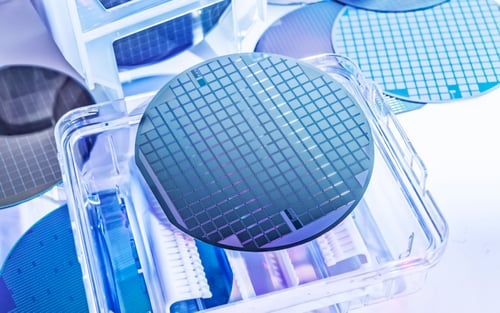
In semiconductor, optical, and technical glass manufacturing, these problems have consequences beyond appearance. A chipped edge can reduce usable yield, while dimensional variation or subsurface damage can create problems during subsequent processing.
Diamond wheels and blades provide the hardness and controlled cutting action required for these materials, but simply specifying "diamond" isn't enough. Bond type, diamond grit size, blade thickness, cutting speed, feed rate, coolant delivery, and material support all affect the quality and consistency of the cut.
Understanding how those variables interact is essential when the objective is repeatable, high-precision glass wafer cutting.
Why Glass Wafers Require a Specialized Approach to Cutting
The starting point is understanding how glass actually responds to a diamond wheel in the first place.
The Brittle Nature of Glass Under a Diamond Wheel
Glass doesn't respond to cutting forces like a ductile metal.
Instead of producing a conventional continuous chip, brittle glass removal can involve microfracture. If forces become excessive or unstable, those fractures can extend beyond the intended cutting zone and appear as edge chips or subsurface damage.
The objective isn't simply to cut through the wafer as quickly as possible. The process must control the size and propagation of those fractures.
A sharp, properly specified diamond wheel helps accomplish this by concentrating the cutting action into many small abrasive contacts rather than forcing the material apart with excessive pressure.
Why Precision Manufacturing Leaves Little Room for Error
Wafer manufacturing adds another level of difficulty because cut quality must remain consistent from one wafer to the next.
Manufacturers may be controlling:
- Wafer thickness
- Kerf width
- Edge chipping
- Surface and edge condition
- Dimensional tolerance
- Flatness
- Subsurface damage
- Material yield
The best cutting process therefore isn't necessarily the one with the highest cutting speed. It is the one that achieves the required throughput while consistently keeping these variables within specification.
Choosing the Right Diamond Wheel Bond for Wafer Cutting
With that behavior in mind, the bond holding the diamond becomes one of the most important specification decisions.
Electroplated Wheels for Aggressive Cutting and Specialized Profiles
Electroplated diamond tools use diamond abrasive mechanically retained in a plated metal layer, typically creating an open, aggressive cutting surface with strong abrasive exposure.
Because there is generally a single abrasive layer rather than a deep abrasive section, electroplated tools can be manufactured in thin or specialized geometries and can provide aggressive initial cutting action.
They can be useful where free cutting, profile capability, or tool geometry is important.
However, electroplated wheels don't renew their abrasive layer in the same manner as a multi-layer bonded wheel. As the exposed diamond wears or is lost, cutting behavior can change.
For a high-volume wafer operation where long-term consistency is critical, that wear behavior must be considered alongside initial cutting speed.
Metal Bond Wheels for Shape Retention and Wheel Life
Metal-bond diamond wheels hold the abrasive within a durable metallic matrix.
Their primary advantages are strong diamond retention, dimensional stability, and long wheel life. Those characteristics can make metal bond attractive for production environments where maintaining wheel geometry over many cuts is important.
The tradeoff is that a strongly retaining bond may require careful specification and conditioning to maintain the desired cutting action. The wheel must continue exposing diamond effectively rather than becoming dull or loaded.
For precision wafer cutting, the goal isn't maximum wheel life at any cost. It is stable cutting performance throughout the usable life of the wheel.
Resin Bond Wheels for Controlled Cutting and Fine Finish
Resin-bond diamond wheels use a polymeric bond matrix that can be engineered to provide a relatively free-cutting action.
This makes resin bond particularly useful where manufacturers are trying to control cutting forces, chipping, and surface quality on brittle materials.
Resin bonds can release or expose diamond differently from metal bonds, helping maintain cutting action as the tool wears. Depending on the application, this can contribute to smoother cutting and reduced forces.
The correct choice ultimately depends on the glass, wafer thickness, desired kerf, required edge condition, and production rate.
There isn't one bond that is automatically best for every glass wafer.
Matching Wheel Selection to Glass Type
Bond type is only part of the equation; the glass material itself also shapes the right wheel specification.
Cutting Quartz and Fused Silica for Semiconductor Applications
Quartz and fused silica are widely used in semiconductor, optical, laboratory, and other high-precision applications because of properties including thermal stability, chemical resistance, and optical performance.
Their brittleness, however, makes cutting conditions important. Research on fused quartz grinding has shown that with the right wheel and process control, a 6–12 μm diamond grinding wheel can produce subsurface damage depth under 0.5 μm, demonstrating how much wheel specification affects the integrity of the finished surface.
Diamond grit size, wheel bond, feed rate, cutting speed, coolant delivery, and wafer support should work together to keep cutting forces controlled and minimize edge damage.
For thin wafers in particular, rigidity becomes increasingly important. A cutting tool that is too aggressive—or a feed rate that creates excessive force—can introduce vibration and increase chipping.
Cutting Optical Glass for Precision Components
Optical glass can impose even more demanding surface and edge requirements because imperfections can affect subsequent finishing operations and potentially the performance of the final component.
Wheel selection should therefore account for what happens after the cut.
A manufacturer performing additional edge grinding, beveling, lapping, or polishing may choose a different cutting strategy than one trying to achieve the best possible as-cut edge.
Many of the same principles—grit selection, bond type, cutting forces, and heat management—also carry into subsequent glass finishing operations.
For a broader look at those processes, see the different styles of glass grinding, including edge finishing, beveling, and other glass grinding operations.
Grit Size and Its Impact on Surface Finish and Yield
Alongside bond and material, grit size plays a direct role in how clean the finished edge turns out.
Coarse Grit for Cutting Efficiency Versus Fine Grit for Edge Quality
Diamond grit size directly influences how the wheel interacts with the glass.
Larger diamond particles generally provide a more aggressive cutting action and larger chip clearance. This can improve cutting efficiency, particularly where greater amounts of material need to be removed.
The tradeoff is that larger abrasive particles can also create larger individual fractures in brittle glass.
Finer diamond grit distributes cutting action across more, smaller abrasive contacts. This can improve edge quality and reduce the severity of chipping, although an excessively fine or poorly matched specification may reduce cutting efficiency or become more susceptible to loading.
How Grit Selection Affects Chipping
Selecting grit is therefore a balance between productivity and edge quality.
If chipping is excessive, simply moving to the finest available diamond isn't always the answer. Feed rate, blade condition, rigidity, coolant delivery, mounting, and spindle condition should also be evaluated.
A finer grit combined with unstable fixturing can still produce a poor cut.
The complete process has to remain stable.
Controlling Heat and Preventing Thermal Damage
Beyond mechanical forces, heat generated during cutting introduces its own set of risks.
Why Glass Is Especially Sensitive to Heat Buildup
Glass is sensitive to temperature gradients.
Grinding and cutting generate heat at the diamond-glass interface. If that heat isn't removed effectively, localized temperature differences can create thermal stresses that contribute to cracking or dimensional instability.
A worn or poorly cutting wheel makes the situation worse because more energy goes into friction instead of productive material removal.
This is one reason cutting performance and thermal control are closely related.
A free-cutting diamond wheel generally requires less force and reduces unnecessary friction at the cutting interface.
Coolant Selection for High-Purity Wafer Applications
Coolant serves several functions during glass wafer cutting.
It removes heat, flushes glass debris from the kerf, helps keep the diamond cutting surface clean, and supports consistent cutting conditions.
For precision glass and semiconductor-related applications, water-based systems and high-purity water are commonly used, depending on the material and downstream cleanliness requirements.
The important factor isn't simply having coolant present.
Coolant must reach the cutting interface consistently.
Poor nozzle positioning, restricted flow, clogged filtration, or an unstable coolant stream can create localized dry cutting conditions even when the machine appears to have adequate coolant.
Minimizing Material Loss and Maximizing Wafer Yield
Heat and forces aside, how much material the wheel itself consumes has a direct impact on overall yield.
Why Wheel Thickness Affects Overall Yield
Every diamond wheel removes a finite width of material. That width—the kerf—is material that cannot become part of the finished wafer.
In wafer manufacturing, relatively small changes in kerf can therefore become economically significant across a large number of cuts.
Narrower controlled kerf means less material removed per cut and potentially more usable material from the starting substrate.
This makes wheel thickness an important consideration.
The thinnest possible wheel isn't automatically the best wheel, however.
As a wheel becomes thinner, rigidity decreases. A blade that deflects or vibrates can create a wider effective kerf, poor straightness, increased chipping, or inconsistent wafer dimensions.
The goal should therefore be the thinnest wheel that remains mechanically stable for the application.
Balancing Cutting Speed With Precision
Increasing production speed can be attractive, but feed rate cannot be considered independently from wheel speed, wheel thickness, glass properties, and machine rigidity.
If feed becomes too aggressive, cutting forces increase. The wheel may deflect, chipping can increase, and the resulting kerf may become less consistent.
Conversely, unnecessarily conservative parameters can reduce productivity without producing a meaningful improvement in cut quality.
The optimal process is usually established through controlled testing that evaluates cutting rate against measurable outputs such as kerf, chipping, dimensional accuracy, and wheel wear.
Maintaining Contamination Control in Semiconductor Applications
For semiconductor-grade work, yield isn't the only concern, cleanliness matters just as much.
Why Coolant Purity Affects Wafer Integrity
In semiconductor-related manufacturing, cleanliness can be just as important as dimensional accuracy.
Coolant can carry particles removed from the glass, wheel wear debris, contaminants from previous operations, and impurities from the coolant system itself.
If those contaminants are allowed to recirculate, they can affect subsequent cuts or create additional cleaning requirements.
Filtration and coolant maintenance should therefore be treated as part of the wafer cutting process rather than general machine maintenance.
Preventing Cross-Contamination During Cutting
Machines used for multiple materials deserve additional attention.
Cutting glass after another ceramic, semiconductor, or composite material can introduce particles from the previous operation into the coolant or cutting area.
Where contamination limits are strict, manufacturers may need dedicated coolant systems, appropriate filtration, thorough machine cleaning, or dedicated equipment.
The correct approach depends on the cleanliness requirements of the finished wafer and downstream manufacturing process.
Achieving Repeatability in High-Volume Production
Once individual variables are dialed in, the next challenge is holding that performance steady across a full production run.
Setting Cutting Speed and Feed Rate for Stable Results
The best cutting parameters are not simply the fastest settings that successfully complete one cut.
Production parameters need to produce the same result repeatedly as the diamond wheel wears.
Establishing a stable process means monitoring variables such as:
- Feed rate
- Wheel speed
- Spindle load
- Coolant flow
- Kerf width
- Edge chipping
- Wheel wear
- Finished wafer dimensions
If edge quality gradually deteriorates during production, that trend can indicate changes in wheel condition before outright failure occurs.
Why Wheel Consistency Matters Across Production Runs
High-volume wafer cutting also requires consistency from one wheel to the next.
Variations in diamond grit distribution, bond characteristics, wheel thickness, geometry, or abrasive concentration can translate into changes in cutting forces and edge quality.
This is why wheel specification and manufacturing consistency become particularly important once a process has been qualified.
A successful precision process isn't built around finding a wheel that works once. It requires a wheel specification that can be reproduced reliably.
Choosing the Right Diamond Wheel for Your Wafer Application
Bringing all of these variables together is ultimately where wheel selection starts.
Matching Bond Type and Grit to Your Specific Glass Material
Diamond wheel selection should begin with the glass and the finished-part requirements.
An application engineer will typically consider:
- Glass composition
- Wafer or substrate thickness
- Required kerf width
- Wheel diameter and thickness
- Required edge quality
- Acceptable chipping
- Cutting depth
- Cutting speed and feed rate
- Machine rigidity and spindle characteristics
- Coolant type and flow
- Production volume
- Downstream finishing requirements
Those variables determine whether electroplated, metal bond, resin bond, or another diamond wheel construction provides the best balance of cutting efficiency, wheel life, edge quality, and dimensional stability.
Working With an Application Engineer for a Custom Solution
For precision glass wafer cutting, small changes in wheel specification can produce meaningful changes in the process.
A thinner wheel may reduce kerf but require additional rigidity. A finer grit may improve edge quality but reduce cutting efficiency. A more durable bond may improve wheel life but change how the wheel remains free-cutting.
These aren't independent decisions.
They need to be evaluated as a system.
Working with an application engineer allows the wheel specification to be developed around the actual glass, machine, cutting conditions, and finished-part requirements instead of selecting a generic diamond blade based primarily on diameter and thickness.
Partner With Eagle Superabrasives for Precision Wafer Cutting Solutions
Cutting glass wafers successfully requires balancing competing objectives: narrow kerf, minimal chipping, dimensional accuracy, cutting speed, wheel life, contamination control, and consistent production.
Diamond wheels provide the cutting ability needed for brittle technical glass, but the best results come from matching the complete wheel specification to the application.
Bond type determines how the wheel holds and exposes diamond. Grit size affects cutting action and edge quality. Wheel thickness influences kerf and rigidity. Coolant controls heat and removes debris. Speed and feed determine how aggressively the wheel interacts with the glass.
When those variables are engineered together, manufacturers can reduce chipping and material loss while improving repeatability across production runs.
Eagle Superabrasives works with manufacturers to develop diamond wheel specifications around the specific glass material, machine, wafer dimensions, finish requirements, and production goals—helping turn diamond wheel selection into a controlled part of the precision manufacturing process. Connect with our team to work with an application engineer on a diamond wheel built for your material and tolerances.